

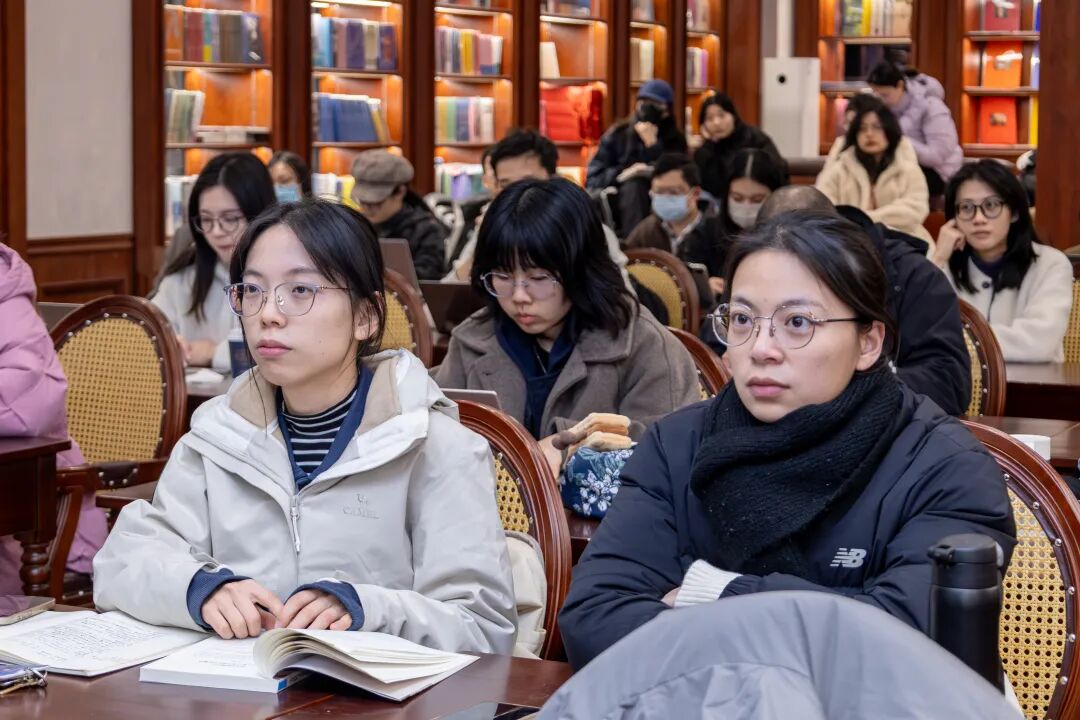
Recently, the 21st Academic Salon of the Seeking Truth and Authenticity in the Media Circle was held at the Zhongxi Bookstore · Dazhong Bookstore (Zhejiang University Campus Bookstore). This event was jointly organised by the Digital Communication Research Centre, the School of Media and International Culture, the Digital Social Sciences Research Initiative, and the Institute of Aesthetics and Critical Theory at Zhejiang University. Professor Jin Wen, holding dual appointments at the Department of Chinese Language and Literature and the School of International Chinese Language and Culture at East China Normal University, delivered a lecture entitled The 'Randomness' of Emotion and History. The event was chaired by Professor Fan Yun from Zhejiang University's School of Communication and International Culture, with participation from Huang Dan, Senior Professor of Humanities at Zhejiang University and Director of the Digital Communication Research Centre, alongside dozens of faculty members and students.

Emotion stands as one of the most vital mediators in contemporary society, serving as an implicit tool through which humans perceive the world and construct social structures. It introduces random kinetic energy into the evolution of human society, rendering the deepening of literary emotion studies of significant practical importance. In this lecture, Jin Wen approaches the subject through the "randomness" inherent in the constitution of emotion. Through interdisciplinary theoretical dialogue, she attempts to bridge social evolutionary theory with affect/emotion theory, linking the randomness of affect with the randomness of history. Building upon previous quantitative research on emotion, she introduces the concept of "affect" to explore pathways for emotion studies to engage more closely with the randomness of the material world.
The first section of the lecture centred on the foundational theory of "emotion and 'randomness'" and Jin Wen's recent reflections on affect research. After engaging with American psychologist Tomkins' affect theory and its developments in neuroscience, Deleuze's affect theory based on Spinoza's 'conatus', and William Reddy's theory of constructed emotion, she proposes that 'emotion' is 'emotional practice'. She supplements the longstanding debate within psychology and neuroscience between "basic affect theory" and "constructed affect theory," elucidating the origins of her affect theory.
Additionally, Jin Wen introduces interdisciplinary research to articulate her new reflections on affect: firstly, drawing from studies of bodily kinetic energy in physics, she posits that material bodies constitute the source of consciousness's noise and randomness, and explores the relationship between weak perception and affect; Secondly, drawing upon neuroscience research into visceral perception, she elucidates the constitutive role of bodily kinetic energy in shaping emotion/affect. She reveals that the connection between affect and randomness constitutes emotion's fundamental challenge to algorithmic systems, proposing two forms of "randomness" in affect generation at both individual and collective levels.
In the second section, Jin Wen presented "Quantitative Research on Symbolic Emotions," introducing four approaches to quantifying emotions for studying societal development patterns: firstly, within econometrics, economists seek to transform emotions into manipulable variables for constructing economic models and forecasting, giving rise to fields like affective economics and "happiness economics"; Second, following the advent of AI, researchers employ machine learning to enable large language models to recognise emotions within text, giving rise to "affective computing" – such as training artificial intelligence to learn 27 emotional clusters; Third, building upon affective computing, AI-assisted "digital humanities research" addresses grand questions such as "the connection between political-economic shifts and the evolution of human consciousness." For instance, economists have employed AI to discern correlations between fundamental emotions and economic cycles across tens of thousands of images spanning six centuries; Fourthly, "emotion management" emerged, exemplified by researchers over two decades ago attempting to design "game simulation systems incorporating agent emotional computation" and the recently published "social simulation platform".
。
In the third section, Jin Wen explored "possible pathways for forging closer links between affective studies and the contingency of the material world," outlining four approaches to integrating affect into both quantitative and qualitative emotional research.
The first approach involves text-based qualitative research that explores the "potential" within individual texts, including bodily writing and atmospheric depictions. This demonstrates how texts introduce variables within prevailing ideologies, elucidating the agency of creators—including the collaborative agency between humans and machines. Here, she employs rich case studies—such as Shakespeare's portrayal of Othello and early modern England's culture of appearance—to elucidate affect's socialised production and interpretation.
The second approach emphasises the constitutive role of material environments and embodied actions in shaping affect, countering affect management techniques to construct a critical theory of affective governance. It reflects on how affect management manipulates people's emotions, linking affective governance critique with emerging research on affective labour, the phenomenology of ambience, and studies of the affect economy (endorphin economy) within contemporary cultural studies.
The third possibility, central to Jin Wen's lecture, involves "combining theoretical reflection with empirical research to examine historical randomness and phasicity." First, she invokes the "random-aggregate effect" in economic history from scholar Kurt and Badiou's "ruptures of history" to demonstrate randomness's force in historical inflection points. Through metaphors of body and polity in Hypnosis and the End of the French Enlightenment, alongside Spinoza's panentheistic union of spirit and matter and its connection to Eastern learning's transmission to the West, she re-examines the randomness of Western modernity's emergence. Secondly, drawing upon the random evolutionary perspectives in economic history embodied by scholars such as Wallerstein and Peng Mulan, she posited that the cultural dimensions of Western modernity likewise possess global origins. European modernity emerged as an interwoven process of long-term trend forces and random convergent forces interacting both internally and externally. New understandings of subjectivity in mind-body relations within Eastern works exerted a certain catalytic influence on the formation of Western modern cultural concepts.
Finally, Jin Wen concludes that pivotal historical turning points are determined by multiple factors. This notion of "multiple determinism" originates from Althusser, whose core thesis emphasises the pluralistic nature of historical momentum. The October Revolution exemplifies how "historical randomness is often linked to shifts in cultural atmosphere, and such cultural shifts constitute affective movements, thereby connecting the randomness of affect with the randomness of history." Additionally, Jin briefly outlined a fourth pathway, grounded in China's specific context, for exploring affective governance within contemporary Chinese culture.
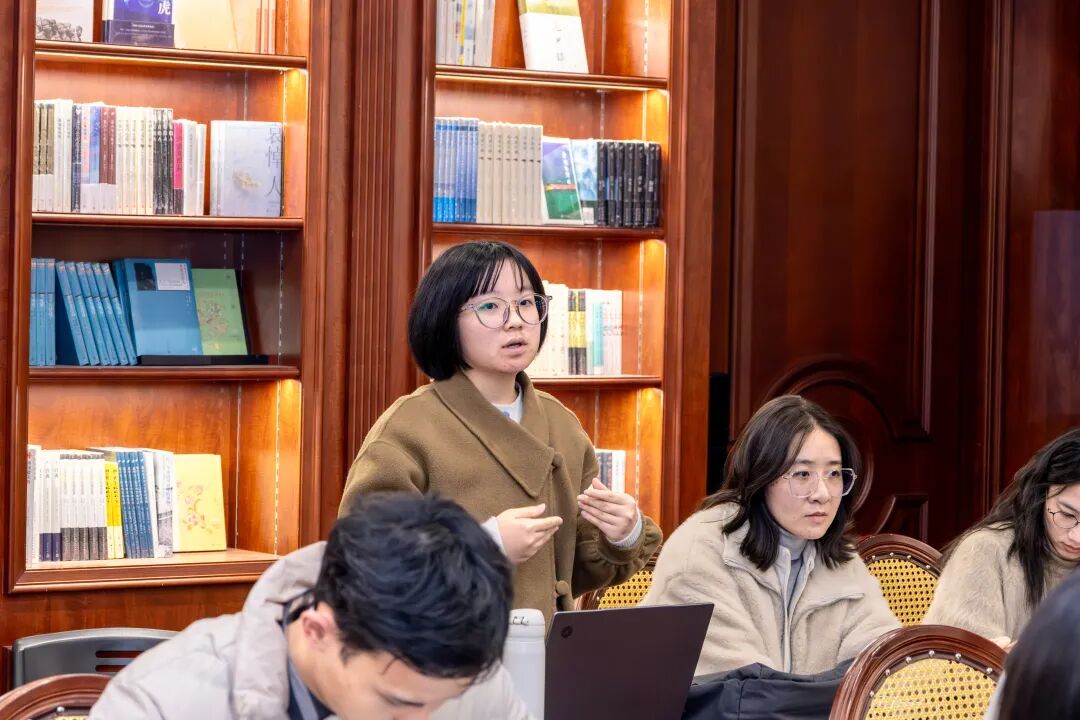
Following Jin Wen's presentation, several faculty members and students raised questions concerning: "The tra
nslation of 'Affect'", "The distinction between Deleuze's theory of affect and Masumi's theory of affect", "Whether, in Spinoza's era, affect or historical contingency might have been deemed blasphemous against God", "Subsequent scholars' divergent assessments of Spinoza's thought", and "Whether translating 'Affect' as 'affect' aligns with the verb ' whether affect or historical contingency might have been deemed blasphemous against God in Spinoza's era," "subsequent scholars' divergent assessments of Spinoza's thought," and "whether translating 'Affect' as 'affective' relates to its verb form or influence." Drawing upon both the lecture's content and her prior research, Jin Wen addressed each query in turn, engaging in profound exchanges with the attendees.