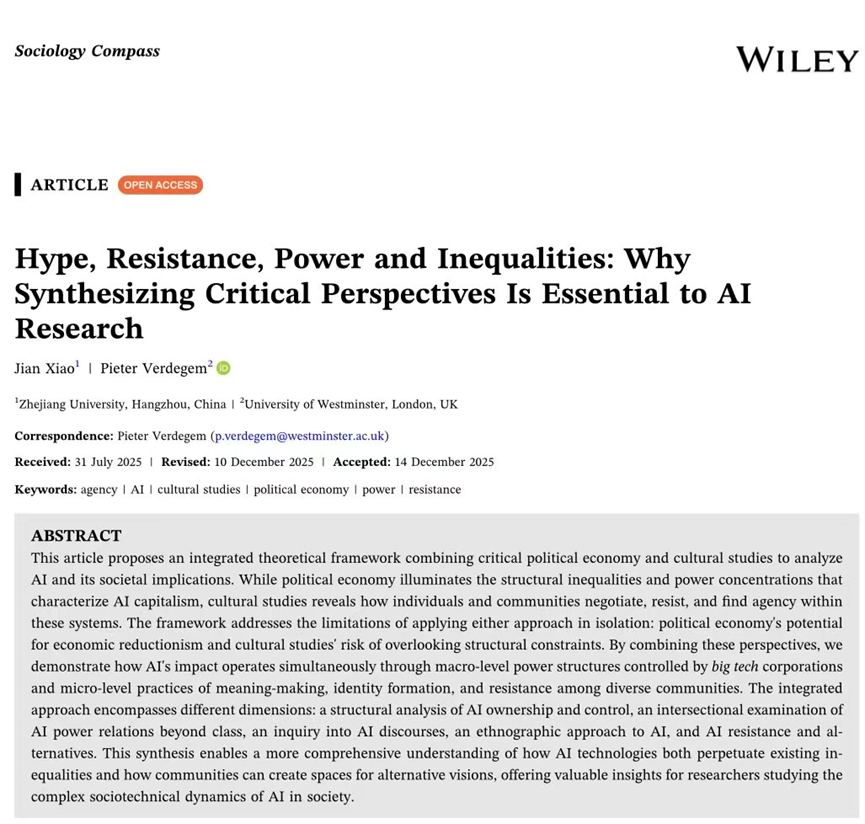
Recently, Xiao Jian, a researcher in the Hundred Talents Programme and thesis supervisor at the Institute of Aesthetics and Critical Theory, collaborated with Professor Pieter Verdegem of the University of Westminster to write the research article Hype, Resistance, Power and Inequality: Why the Synthesis of Critical Perspectives is Essential to AI Research. The article has been invited for publication in the leading sociological journal Sociology Compass. This article proposes an innovative methodology for AI research, based on a synergistic perspective that bridges the Global South and the Global North, as well as cultural studies and political economy.
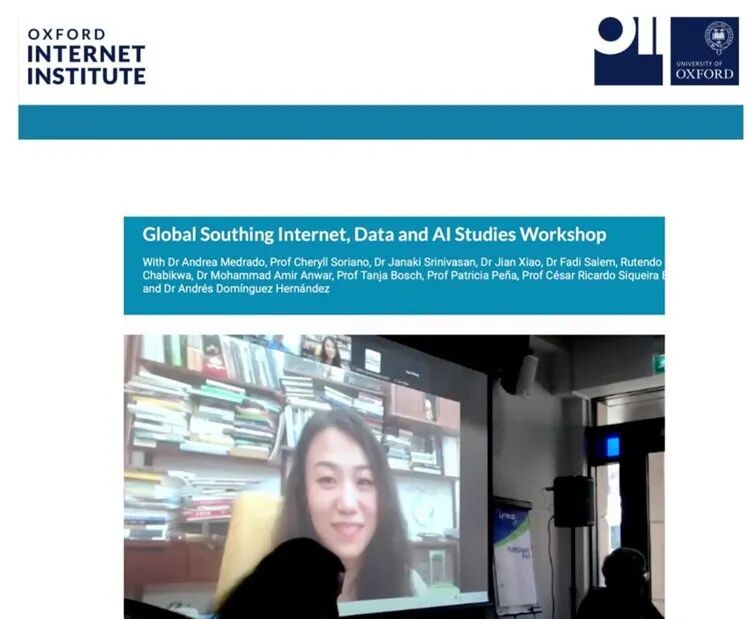
On the strength of these findings, Xiao Jian was subsequently invited to speak at the Oxford Internet Institute symposium on The Internet, Data and AI Research in the Global South and participated in academic exchanges with the University of Cambridge's History of Artificial Intelligence: Genealogies of Power project group. He has given specialist lectures focusing on research on the internet, platforms and AI in the context of the Global South.
This paper proposes an integrated theoretical framework combining political economy and cultural studies to analyse artificial intelligence and its societal impacts. This framework addresses the limitations inherent in relying solely on either discipline: political economy risks falling into economic determinism, while cultural studies may overlook structural constraints. By integrating these dual perspectives, the research reveals the dual operational mechanisms of AI's influence—operating both through macro-level power structures controlled by tech giants and through micro-level processes of symbolic construction, identity formation, and resistance practices within diverse communities. This integrated framework encompasses five dimensions: structural analysis of AI ownership, examination of intersectional power relations beyond class perspectives, exploration of AI discourses, ethnographic approaches to AI research, and investigation of AI resistance and alternative solutions. This integrated perspective offers a more comprehensive understanding of how AI technologies simultaneously reinforce existing inequalities and how communities create spaces for alternative visions, providing significant insights for sociological researchers studying the socio-technical complexities of AI.
LINK:
//compass.onlinelibrary.wiley.com/doi/10.1111/soc4.70155
Pieter Verdegem serves as Programme Director for the MA in Artificial Intelligence, Data and Communication within the joint dual-master's degree programme offered by the School in collaboration with the University of Westminster. He is a leading expert in the field of the political economy of communication.